


Views: 0 Author: Site Editor Publish Time: 2026-06-25 Origin: Site


Architectural facade projects demand high precision, strict aesthetic standards, and superior structural integrity. In modern construction, scalable panel fabrication quickly becomes a primary bottleneck. Engineers must produce perfectly flat, visually flawless surfaces on massive scales to meet ambitious architectural designs. Traditional fabrication methods often struggle to meet these demands efficiently. They rely heavily on secondary operations for ventilation, stiffening, and fastening. Moving large aluminum sheets between different workstations increases handling risks and drives up overall production times.
You need a streamlined approach to remain competitive. Strategic investment in specialized CNC Punch Press Tooling solves this dilemma directly. It allows fabricators to consolidate operations, prevent surface defects, and scale aluminum curtain wall production effectively. This guide reveals how modern fabrication centers shift from simple hole-punching to advanced sheet metal forming. You will learn specific strategies to eliminate manual deburring, protect delicate finishes, and optimize tool paths for maximum output.
Consolidated Operations: Advanced tooling enables in-machine forming (louvers, beadrolls, extrusions), eliminating the need for secondary manual processes.
Defect Mitigation: Specialized non-marking dies and stripper plates prevent scratching on high-value aesthetic aluminum surfaces.
Structural Integrity: Integrating stiffening ribs via CNC turret punch tooling reduces "oil-canning" on large-span architectural panels.
Tool System Compatibility: Selecting the correct tooling architecture (Thick vs. Thin Turret) directly impacts alignment accuracy and tool longevity.
Large-format aluminum panels dominate modern curtain wall designs. These expansive metal sheets present unique manufacturing challenges. They are highly prone to warping during heavy punching cycles. Multi-step manufacturing processes introduce severe risks of surface marring. Every time a technician lifts, flips, or moves a highly polished panel to a new workstation, the risk of aesthetic damage skyrockets. Scratches on architectural panels often lead to immediate client rejection. High scrap rates destroy project profitability.
Fabricators must define clear success criteria when upgrading their manufacturing approach. Simply buying faster machines rarely solves the root issues. True operational success requires a strategic overhaul of how metal moves through the shop floor. Consider these primary success criteria for upgrading your fabrication process:
Total elimination of secondary downstream processes, such as manual deburring and offline bracket welding.
Achieving zero aesthetic defects prior to the anodizing or powder coating stages.
Measurable reduction in floor-to-floor cycle times for complex panel assemblies.
Achieving these goals requires a fundamental shift in mindset. You must stop treating the equipment as a simple hole-making machine. Instead, you should utilize it as a comprehensive sheet metal forming center. Modern punch presses command enough tonnage to form, bend, and shape aluminum directly on the machine bed. Consolidating these operations minimizes part handling. Fewer touches translate directly to fewer mistakes, lower scrap rates, and accelerated delivery schedules.
Large, flat aluminum panels often suffer from "oil-canning." This phenomenon describes the visible waviness or buckling that occurs across broad metal spans under thermal expansion or wind loads. Traditionally, fabricators welded heavy stiffening channels to the back of the panel to prevent this flex. Welding introduces intense heat, which frequently causes localized warping and ruins the panel's exterior finish.
Bead roller tools offer a superior alternative. They roll continuous structural ribs directly into the flat aluminum panel while it remains on the machine. Upper and lower wheels pinch the material, creating a rigid geometric shape. This continuous forming adds immense strength. It prevents oil-canning entirely without requiring heavier, cost-prohibitive material thicknesses. You achieve structural integrity in a single setup.
Curtain walls require integrated airflow and drainage systems to manage moisture and regulate building temperatures. Manufacturers often cut massive holes and weld separate louver sub-assemblies into the panels. This method is slow and introduces potential failure points for water ingress.
Lance and form tools create integrated airflow vents directly on the press. The tool cuts and forms the louver in a single progressive stroke. It replaces welded sub-assemblies entirely. This method ensures strict dimensional repeatability. Every louver matches perfectly, guaranteeing weather-tight facade performance. You eliminate the labor-intensive fitting process and achieve a cleaner architectural aesthetic.
Mounting heavy aluminum panels to the building skeleton requires robust fastening points. Drilling and tapping holes manually is a tedious, error-prone task. Traditional drilling leaves burrs that interfere with flush-mount hardware.
Advanced extrusion tools plunge into the sheet, drawing the metal downward to form a precise cylindrical collar. A secondary tapping tool then cuts clean threads into this extended collar directly on the press. This combination guarantees precise structural mating for brackets and mullions. It eliminates secondary drilling operations entirely. You provide installation crews with ready-to-assemble panels right off the fabrication line.
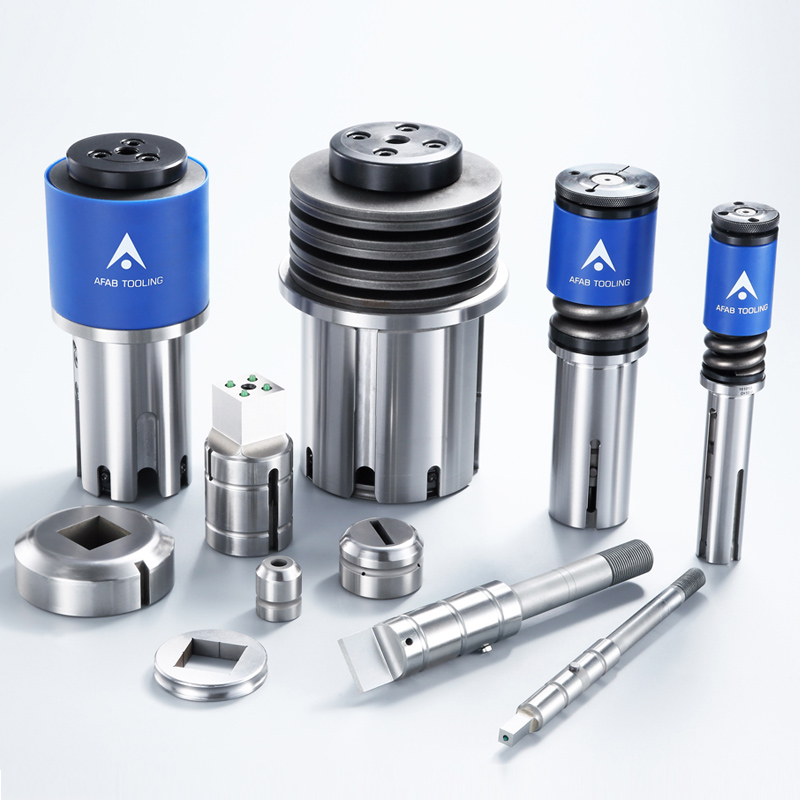
The foundation of reliable in-machine forming lies in the tooling system architecture. Different machine OEMs utilize specific tooling styles, each offering distinct advantages for heavy-duty aluminum punching. Understanding these architectures helps you optimize machine performance.
Below is a chart comparing the primary tooling architectures used in curtain wall manufacturing:
Tooling Architecture | Primary Characteristic | Best Use Case for Aluminum Facades |
|---|---|---|
Thick Turret (Amada/Mate style) | Longer guide lengths and superior punch body rigidity. | Heavy forming, deep extrusions, and large louver creation. |
Thin Turret | Shorter guide lengths with lighter overall tool weight. | High-speed perforation on lighter gauge aesthetic panels. |
Trumpf-style (Linear Rail) | Single punch head with automated tool rail delivery. | Complex, multi-tool setups requiring frequent, rapid tool changes. |
When selecting CNC turret punch tooling for thick architectural-grade aluminum, alignment and rigidity are paramount. Forming operations generate significant lateral forces. If the tool guiding system lacks rigidity, the punch will deflect upon impact. Deflection causes uneven die clearances, rapid tool wear, and poor part quality. Highly rigid guiding systems prevent this deflection. They ensure the punch enters the die perfectly straight, even under the immense stress of forming 3mm or 4mm aluminum panels.
Material adhesion presents another major hurdle. Aluminum is a relatively soft, highly adhesive metal. During repetitive punching, microscopic aluminum particles weld themselves to the punch tip. This process, known as galling, degrades the tool edge and creates severe scratching on the panel surface. Premium tool steels, such as powder metallurgy (PM) grades, resist edge wear better than standard M2 steel. Furthermore, you must apply specialized tool coatings to prevent galling. Coatings like Titanium Carbonitride (TiCN) or proprietary Maxima finishes provide exceptional lubricity. They act as a barrier between the steel and the aluminum. These coatings drastically extend maintenance cycles and protect the pristine finish of your facade panels.
Designing facade components specifically for punch press manufacturing guarantees smoother production runs. A proactive Design for Manufacturability (DFM) approach mitigates common fabrication risks before the first sheet hits the machine bed.
Implementing surface protection strategies is the most critical DFM step for architectural panels. Pre-finished or highly polished exterior panels scratch easily during processing. You must eliminate metal-to-metal friction wherever possible. Follow these steps to safeguard panel aesthetics:
Deploy Urethane Strippers: Replace standard steel stripper plates with urethane alternatives. Urethane firmly holds the sheet flat during extraction without leaving impact rings or scuffs.
Utilize Non-Marking Die Mats: Insert specialized recessed dies or urethane die mats. These prevent the bottom of the aluminum sheet from rubbing against hard steel die edges during machine movement.
Install Brush Tables: Ensure the machine bed features high-density brush tables instead of steel ball transfers. Brushes support heavy aluminum sheets smoothly and sweep away abrasive debris.
Sheet distortion management requires careful programming. Punching hundreds of holes introduces massive residual stress into the metal. If you punch holes sequentially from one edge of the panel to the other, the metal will stretch and curl. You must distribute punching stresses evenly across the panel. Advanced nesting software optimizes tool sequencing. It alternates punching locations, effectively balancing the internal stresses. This strategic sequencing keeps the aluminum panel perfectly flat, ensuring it mounts flush to the building exterior.
Finally, clearance optimization ensures clean cuts. Punch-to-die clearance must match the specific structural aluminum alloy you process. Softer 3000 series aluminum requires tighter clearances to shear cleanly without leaving large burrs. Harder 5000 series architectural aluminum needs slightly looser clearances. This allows the material to fracture properly during the punch stroke. Incorrect clearances lead to slug pulling. Slug pulling occurs when the punched scrap lifts out of the die and lands on the sheet. The next punch hit forces the slug into the panel, instantly ruining it. Calculating precise clearances eliminates burrs, prevents slug pulling, and guarantees a flawless edge.
Hardware upgrades alone cannot transform your production line. You must synchronize your specialized tooling strategy with modern CNC programming to unlock true manufacturing efficiency. Modern nesting software bridges the gap between architectural intent and machine capability.
Advanced CAM software translates complex 3D facade models directly into optimized tool paths. The software understands the precise geometry of your forming tools. It automatically calculates the exact hit increments required to roll a bead or form a continuous louver. This software synchronization eliminates manual coding errors. It ensures the machine utilizes forming tools safely, without colliding with adjacent clamps or features.
Minimizing turret index time significantly reduces overall floor-to-floor cycle times. High-density perforated facade designs demand thousands of tool strikes. Rotating the turret to change tools takes valuable seconds. Leveraging multi-tools and cluster punches solves this inefficiency. A single cluster punch creates multiple holes in one hit. Multi-tool stations hold up to eight individual punches in a single turret location. The machine drops the internal ram to select different tools instantly, completely bypassing turret rotation. This strategy slashes production times on complex architectural patterns.
Measuring efficiency gains requires a clear framework. You must evaluate the holistic impact of in-machine forming on your production schedule. Below is a summary table detailing how to measure these operational improvements:
Efficiency Metric | Measurement Method | Expected Impact from Advanced Tooling |
|---|---|---|
Labor Reallocation | Track hours spent on manual deburring and secondary drilling. | Complete elimination of secondary drilling stations via extrusion tools. |
Scrap Reduction | Measure the volume of panels rejected for surface scratches. | Drastic drop in rejections due to urethane strippers and non-marking dies. |
Machine Uptime | Monitor hours of continuous punching between tool sharpening. | Extended run times achieved through premium TiCN tool coatings. |
By factoring in labor saved on secondary operations, reduced scrap rates, and increased machine uptime, the operational benefits become undeniable. Your facility shifts from reacting to bottlenecks to predictably scaling output.
Upgrading your punch press strategy transforms a standard fabrication process into a highly efficient, high-yield production line. The architectural demands for visually flawless, structurally sound aluminum curtain walls will only increase. Relying on outdated secondary operations jeopardizes your ability to deliver large-scale projects on time.
When selecting a tooling partner, rely on strict shortlisting logic. Base your supplier selection on their deep engineering support and custom profile capabilities. Ensure they possess a robust catalog of non-marking solutions designed specifically for aesthetic aluminum processing.
Take immediate action to optimize your floor. Audit your current secondary operations today. Identify every workstation dedicated to manual deburring, offline tapping, or manual louvering. These are your immediate opportunities for in-machine forming integration. Request a pilot tooling run from a specialized manufacturer to validate these solutions on your most challenging facade panels.
A: Bead rolling creates continuous geometric ribs across the metal. This continuous forming disrupts the large, flat spans of sheet metal. It adds significant geometric rigidity. This increased structural strength prevents the panel from flexing or buckling under heavy wind loads and thermal expansion.
A: Yes. Advanced extrusion tools plunge and draw the metal to create a precise cylindrical collar. An in-machine tapping tool then cuts clean threads into this collar. This process provides ready-to-assemble mounting points for curtain wall brackets, eliminating offline drilling.
A: Preventing galling requires premium tool coatings like Titanium Carbonitride (TiCN) to increase lubricity. You must also maintain optimized punch-to-die clearances and utilize proper automated lubrication systems. Misting systems apply a micro-layer of oil, further preventing metal-to-metal micro-welding.
A: Non-marking tools eliminate abrasive contact. They use soft urethane inserts within the stripper plates to hold the material flat without denting. Recessed dies and optimized stripper plate pressures prevent harsh metal-to-metal friction from ruining the visible exterior face of the panel.


