


Views: 0 Author: Site Editor Publish Time: 2026-09-24 Origin: Site


Custom sheet metal profiles often require more than standard cutting and bending. Channels, ribs, offsets, tabs, louvers, beads, irregular openings, locating features, and other non-standard geometries can place very different demands on the tooling compared with simple round holes or straight bends.
The right sheet metal fabrication tooling allows manufacturers to create these profiles with greater repeatability while reducing manual rework and unnecessary secondary operations. Depending on the geometry, production strategy may involve Thick Turret Tooling, custom punches and dies, wheel tools, lance-and-form tooling, slitting tools, forming tools, or dedicated press brake tooling.
Efficient tooling selection begins with the finished profile rather than with the machine alone. Material, thickness, bend radius, feature height, tolerances, production quantity, and downstream assembly requirements should all be evaluated before the custom tool is designed.
A custom profile is a sheet metal geometry that goes beyond a basic flat blank with standard holes.
The profile may include a continuous channel, raised rib, offset, locating tab, formed clip, louver, stiffening bead, special opening, edge feature, or a combination of several formed and punched elements.
These profiles appear in electrical cabinets, machinery, transportation equipment, architectural panels, HVAC products, electronics, communication equipment, appliances, and industrial enclosures.
Unlike a simple hole, a formed profile changes the three-dimensional geometry of the sheet. The material must stretch, compress, bend, or flow around the tool. This means tool design must account for how the material behaves during deformation rather than considering only the final dimensions.
For manufacturers using turret punch presses, AFAB TOOL's Thick Turret Tooling system includes standard tooling, special applications, forming tools, Multi-Tool solutions, and accessories for different profile requirements.
Standard punches work efficiently when the required shape already matches a common round, square, rectangle, or slot geometry.
Custom profiles are different because the tooling often needs to control several variables simultaneously.
A formed rib, for example, must reach the required height without tearing the sheet. A lance-and-form feature must cut part of the material while bending another section. A continuous offset must remain consistent across a programmed path. A louver must maintain airflow geometry while remaining within the dimensional limits of the surrounding panel.
Specialized tooling helps control these operations in a repeatable way.
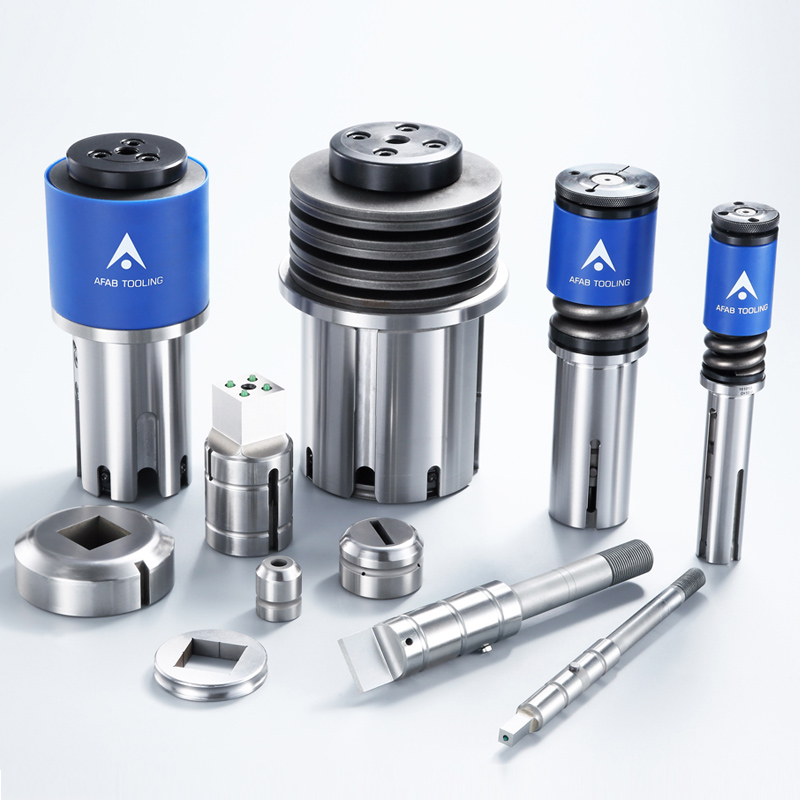
During forming, sheet metal does not simply disappear as it does during punching. The material moves.
A custom punch and die must therefore provide enough space for the sheet to deform while controlling the final shape.
If the radius is too small, the material may crack. If clearance is incorrect, the profile may distort or show excessive marking. If a forming tool forces too much material into a confined area, the surrounding sheet may warp.
This becomes particularly important with aluminum, stainless steel, and high-strength materials because their forming characteristics differ.
The alloy or grade should therefore be known before the final tooling geometry is approved.
A profile can sometimes be produced manually using several individual operations, but that does not mean it is the best production method.
Suppose a component needs a locating tab followed by an offset and a small stiffening rib. Producing each feature separately increases handling and creates more opportunities for dimensional variation.
A properly designed custom tooling solution may combine or simplify these operations so the critical geometry is controlled by the tool itself.
This becomes increasingly valuable as production volume grows.
Tip: When a custom profile repeats across hundreds or thousands of parts, evaluate whether dedicated tooling can replace multiple manual or secondary operations.
Custom punching is often the first option when a profile begins as a non-standard cutout.
Instead of creating an irregular opening through repeated nibbling, a dedicated punch can sometimes produce the entire geometry in one hit.
This approach can improve cycle time and reduce visible nibbling marks.
Custom punches are particularly useful for:
Irregular slots
Keyhole shapes
Connector openings
Mounting profiles
Special ventilation shapes
Cable-management openings
Repeated custom cutouts
Non-standard corner geometries
The economic value increases when the same feature appears frequently.
A laser can cut unusual geometry without dedicated tooling, which makes laser cutting attractive for prototypes or frequently changing designs. However, once the shape becomes stable and production quantities increase, a custom punch may reduce processing time significantly.
The decision should compare lifetime production quantity rather than the cost of the first batch alone.
Nibbling creates a larger or irregular contour by overlapping a series of smaller punch hits.
It provides excellent flexibility because manufacturers can use existing tooling to create many shapes.
However, nibbling can increase cycle time and may leave small witness marks along the cut edge.
A custom punch can create a cleaner profile in fewer hits, but it requires dedicated tooling investment.
For stable products with recurring production, this trade-off often favors custom tooling.
Many custom profiles cannot be created through cutting alone.
Raised and recessed features require a forming operation that intentionally deforms the sheet.
Common examples include:
Embosses
Beads
Ribs
Louvers
Knockouts
Countersinks
Extrusions
Bridges
Clips
Tabs
Lance-and-form features
These can often be incorporated directly into a turret punching operation using suitable forming tooling.
Embosses and ribs can add local stiffness without increasing sheet thickness.
This can be valuable for covers, cabinets, enclosures, flooring panels, and lightweight structures where a completely flat sheet would flex too easily.
AFAB TOOL offers Thick Turret Continuous Emboss / Bead / Rib tooling for programmed continuous profile formation.
Instead of requiring one fixed-length emboss, a continuous forming strategy can follow a programmed path and create longer reinforcing profiles.
This gives designers more freedom to place stiffening features where they are structurally useful.

Louvers combine cutting and forming.
They are widely used where a metal panel needs airflow while still providing mechanical protection.
Electrical cabinets, machine enclosures, HVAC components, transportation products, and equipment housings are common examples.
AFAB's Thick Turret Louver Tool is designed for this type of application.
A louver tool must control both the opening and the formed height. Material thickness, louver length, profile shape, orientation, and spacing all influence the final result.
For panels containing many repeated louvers, dedicated tooling can eliminate substantial secondary forming work.
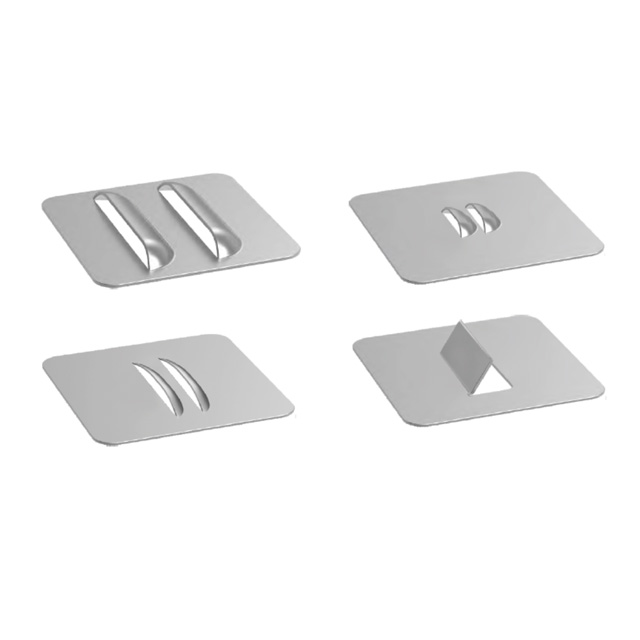
Lance-and-form tooling cuts only part of the sheet and then forms that section upward or downward.
The resulting feature can function as a clip, locator, wire-retaining tab, attachment feature, or airflow opening.
AFAB's Thick Turret Lance and Form tooling supports features such as tabs, clips, locating elements, and wire-harness applications.
This type of profile demonstrates why custom tooling can influence the entire assembly process.
A formed clip produced directly in the sheet may eliminate a separate bracket, fastener, or welding operation.
When design and tooling engineering are considered together, one forming operation can sometimes reduce the total number of components in the assembly.
Some custom features are too long or variable to justify a conventional fixed-length punch.
Wheel tooling provides another approach.
Instead of hitting one stationary shape into the sheet, a rotating wheel forms the material while the machine moves the workpiece along a programmed path.
This makes wheel tooling suitable for continuous profiles.
AFAB's Thick Turret Wheel Tool includes solutions for ribs, offsets, and deburring applications.

A wheel rib tool can produce long stiffening tracks without requiring repeated individual emboss hits.
The machine path controls the location and length of the profile.
This is useful for large panels where stiffness needs to be increased across a specific region.
Electrical cabinets, covers, machinery panels, and architectural components can all benefit from such reinforcement.
Offsets create two sheet surfaces at different heights while maintaining a connecting transition.
They can help components overlap, locate against another panel, accommodate assembly clearances, or create recessed sections.
A wheel offset tool can produce the profile continuously according to the programmed machine path.
This creates more design flexibility than a fixed-length forming tool when several offset lengths are required.
One important advantage of wheel tooling is that the profile does not necessarily need to follow one simple straight line.
Depending on tooling and machine capabilities, the programmed movement can create more complex tracks.
This can allow designers to integrate functional stiffening or locating features without adding separate components.
However, minimum radius, material thickness, machine compatibility, and profile height must still remain within practical tooling limits.
Not every custom profile needs to be produced as a complete punched shape.
Slitting tooling can create controlled cuts that later become part of a formed, folded, or separated profile.
AFAB offers Thick Turret Slitting Tools for cutting sheet metal with different insert geometries.
Slitting can be useful for panel separation, microjoint preparation, edge features, and longer programmed cuts.
Compared with nibbling using a conventional punch, purpose-designed slitting tooling may provide a more efficient cutting path for certain geometries.
The process should still consider sheet distortion. Long cuts can release residual stress inside the sheet, potentially causing movement or loss of flatness.
Cut sequence and part nesting therefore remain important.

Turret tooling handles many local forms, but longer channels, angles, hems, boxes, and open profiles are normally produced on a press brake.
The press brake punch and die determine bend radius, angle, access, and the ability to complete multiple bends without interference.
For custom profiles, tooling selection should be considered during product design rather than after the flat blank has already been finalized.
Material grade and thickness strongly influence safe bend radius.
A highly formable sheet can tolerate a tighter bend than a stronger or harder material.
Trying to create an excessively tight radius may cause cracking along the outside of the bend.
Aluminum deserves particular attention because different alloy and temper combinations can have very different bendability.
The reference manufacturing approach used for aluminum fabrication also highlights the relationship between alloy selection, thickness, bend radius, forming sequence, springback, and surface condition. These same DFM principles apply when custom profile tooling is developed for other materials.
After the press brake releases force, the material partially returns toward its original shape.
This springback changes the final angle.
The amount depends on material strength, thickness, bend radius, die opening, grain orientation, and forming method.
A custom profile containing several bends can accumulate small angular errors until the final cross-section no longer fits the mating component.
Tooling engineers therefore need to consider the entire profile rather than analyzing every bend independently.
A profile may be theoretically bendable but physically impossible with standard tooling.
As earlier bends are added, the workpiece can collide with the press brake punch, die, or machine frame.
This is particularly common with deep channels, narrow boxes, return flanges, and complex Z-shaped profiles.
Gooseneck punches, segmented tooling, special punches, or alternative bend sequences can solve these problems.
Simulation and CAD review are therefore valuable before custom press brake tooling is manufactured.
The same profile cannot always use identical tooling across different materials.
Mild steel, stainless steel, aluminum, galvanized steel, copper, and brass respond differently during cutting and forming.
Material | Main Tooling Consideration | Typical Concern |
|---|---|---|
Mild Steel | Predictable punching and forming | General tool wear |
Stainless Steel | Higher strength and springback | Force, wear, galling |
Aluminum | Soft surface and material adhesion | Galling and scratches |
Galvanized Steel | Coated surface | Zinc buildup and marking |
Copper | Soft and highly ductile | Tool adhesion and surface damage |
Brass | Good formability but visible surface | Cosmetic marking |
High-Strength Steel | Higher mechanical resistance | Tonnage and springback |
Aluminum is attractive for custom profiles because of its low weight and good formability in suitable alloys.
However, profile tooling should account for surface sensitivity and material adhesion.
A profile that will remain visible after fabrication may require smooth tooling, low-friction coatings, protective film, and carefully controlled contact areas.
Harder aluminum alloys also need sufficient bend radii to reduce cracking risk.
Stainless steel can provide excellent durability and corrosion resistance, but stronger grades increase tooling loads.
Springback may make final profile angles more difficult to control, while material adhesion can increase friction around punches and dies.
Correct clearance, suitable tool materials, lubrication, and coatings become increasingly valuable as production volume rises.
Galvanized, pre-painted, or otherwise coated sheet adds a surface-protection requirement to the tooling problem.
A profile may meet every dimensional specification but still be rejected if the tooling damages the visible coating.
Contact pressure, die radii, stripper surfaces, cleanliness, and handling procedures should therefore be incorporated into the process plan.
Custom tooling cannot compensate indefinitely for poor part design.
A profile designed with the manufacturing process in mind will generally be easier to produce, maintain tighter tolerances, and require less complex tooling.
Extremely sharp internal corners concentrate stress in both the material and the tooling.
A practical radius can improve forming reliability and extend tool life without materially changing the function of many components.
This is particularly important for strong or less ductile materials.
Punch tooling also benefits because sharp internal geometry can create vulnerable punch sections.
A louver, emboss, extrusion, or lance feature needs sufficient surrounding material to deform correctly.
Placing the feature too close to an edge, another form, or a bend line can distort the surrounding sheet.
Multiple formed features may also interact when positioned too closely together.
Tooling engineers should therefore review feature spacing before the design is released.
A profile may contain all manufacturable features but still be difficult to produce because the sequence is wrong.
Raised forms can interfere with later machine movement. A deep bend may prevent access to another flange. An early louver operation may create clearance problems during subsequent punching.
In some applications, formed features should be completed near the end of the turret program.
Likewise, press brake sequences should be planned so that every subsequent bend remains physically accessible.
Custom profiles do not require every feature to be custom.
Standard round holes, slots, countersinks, common radii, and familiar bend angles can still be used around the specialized portions of the part.
Standardization reduces tooling cost and improves replacement availability.
A good DFM strategy uses custom tooling only where it creates measurable value.
Custom tooling should not automatically be selected for every unusual profile.
Manufacturers should compare it against laser cutting, conventional punching, press brake forming, machining, welding, and assembly.
The best process depends heavily on production volume and feature complexity.
During prototyping, the design may still change frequently.
Laser cutting combined with conventional bending often provides excellent flexibility because geometry can be modified through programming without redesigning dedicated punch tooling.
This allows engineers to validate the part before committing to custom tooling.
Once the design becomes stable, custom punches or forming tools can begin to provide substantial value.
The tooling cost can be spread across more parts, while faster cycle times and fewer secondary operations lower the effective cost per component.
This is often where sheet metal fabrication tooling has the strongest balance between flexibility and productivity.
At higher quantities, dedicated tools become increasingly attractive.
If one custom profile eliminates several manual forming, welding, machining, or assembly operations, the savings can accumulate rapidly.
For extremely high-volume parts, manufacturers may eventually evaluate dedicated stamping or progressive dies.
The correct production strategy can therefore change as the product moves from prototype to mature mass production.
Custom profile tooling requires more technical information than ordering a standard round punch.
A useful tooling request should normally include:
Machine manufacturer and model
Tooling system
Station size
2D drawing
3D model where available
Material grade
Material thickness
Tensile or mechanical properties where relevant
Desired profile dimensions
Form height
Bend or form radius
Orientation
Required tolerances
Surface-quality requirements
Production quantity
Current manufacturing method
Problems with the existing process
Sample parts where useful
A drawing should clearly distinguish between cut dimensions and formed dimensions.
For special profiles, section views are particularly important because a top view may not show form height, draft, offsets, or bend geometry.
AFAB TOOL states that it uses CAD and 3D design capabilities for tooling development and supplies both standard and customized punching and bending solutions. Its product portfolio includes Thick Turret Tooling, Trumpf, Murata, Thin Turret, Salvagnini, forming, special-application, and related tooling systems.
Tip: For a custom profile, send the supplier the finished-part drawing and explain the function of the feature. The functional requirement may allow a simpler and more reliable tooling solution than reproducing the original geometry exactly.
The lowest tooling quotation does not necessarily produce the lowest manufacturing cost.
A better evaluation looks at the total process.
A custom tool can justify a higher initial price if it eliminates an operation, reduces setup time, improves part consistency, or extends tooling life.
Important cost factors include:
Tool design complexity
Tool material
Surface coating
Station size
Number of operations replaced
Expected tool life
Regrinding capability
Replacement component cost
Setup time
Production quantity
Scrap reduction
Secondary processing
Assembly savings
For example, a lance-and-form feature may replace a welded clip. A continuous rib may allow a thinner sheet while maintaining stiffness. A custom cutout punch may replace repeated nibbling. A wheel offset may eliminate an additional press brake operation.
These savings are not visible when comparing tooling purchase prices alone.
Manufacturers should evaluate cost per acceptable finished part over the expected production life.
Custom tooling often represents a larger investment than standard punches, so maintenance deserves more attention.
Cutting edges should be sharpened before excessive wear develops. Forming surfaces should remain smooth and free from embedded material. Guides, springs, inserts, strippers, and replaceable components should be inspected regularly.
Profile quality can also provide early warning of tool wear.
Changes in burr height, form depth, angle, surface marks, stripping force, or dimensional consistency may indicate that maintenance is required.
Custom tooling should also be stored carefully. A small dent on a precision forming surface can reproduce the same defect on every future component.
Maintenance records can track hit count, sharpening history, coating condition, material processed, and recurring production problems.
This turns tooling maintenance from reactive repair into planned production control.
Sheet metal fabrication tooling for custom profiles allows manufacturers to move beyond simple holes and straight bends.
Custom punches can create non-standard openings efficiently. Forming tools can produce louvers, ribs, embosses, clips, knockouts, and other three-dimensional features. Wheel tooling can generate continuous ribs and offsets, while specialized press brake tooling can produce channels, return flanges, and complex bent profiles.
The best tooling solution depends on material, sheet thickness, geometry, tolerances, form height, surface requirements, production quantity, and downstream assembly.
Design for manufacturability is equally important. Practical radii, sufficient feature spacing, correct forming sequence, and appropriate material selection can simplify tooling and improve process reliability.
AFAB TOOL Co., Ltd. provides punching and bending tooling for different sheet metal production systems. Its Thick Turret Tooling range includes standard tools, Special Applications, Multi-Tool systems, forming tools, and accessories for both conventional and custom sheet metal profiles.
For manufacturers developing custom profiles, the most effective approach is to treat tooling, part design, material, machine capability, and production volume as one connected manufacturing system rather than separate decisions.
A: It refers to punches, dies, forming tools, press brake tools, wheel tools, and other specialized tooling designed to create non-standard cut or formed sheet metal geometries.
A: Custom punches are particularly useful when the same irregular opening or profile is produced repeatedly and standard tooling would require excessive nibbling or multiple operations.
A: Yes. Thick Turret Tooling can produce features such as louvers, embosses, ribs, knockouts, extrusions, lance-and-form features, and other formed geometries with suitable tooling.
A: A wheel tool can create continuous profiles such as ribs or offsets while the sheet moves through the punch press according to the programmed path.
A: It depends on volume and geometry. Laser cutting is highly flexible for prototypes and changing designs, while custom punch tooling can become more efficient when the same profile is produced repeatedly.
A: Material grade, thickness, bend radius, tooling geometry, springback, grain direction, machine condition, and bend sequence can all affect final profile accuracy.
A: Provide machine model, tooling system, drawings, material, thickness, profile dimensions, form height, tolerances, surface requirements, expected quantity, and details of the current process.
A: Standardize common features, simplify unnecessary geometry, use custom tooling only where it replaces meaningful processing, and evaluate cost per finished part rather than tooling price alone.


